No products in the cart.

When the art of stitching becomes gentle therapy for the soul.
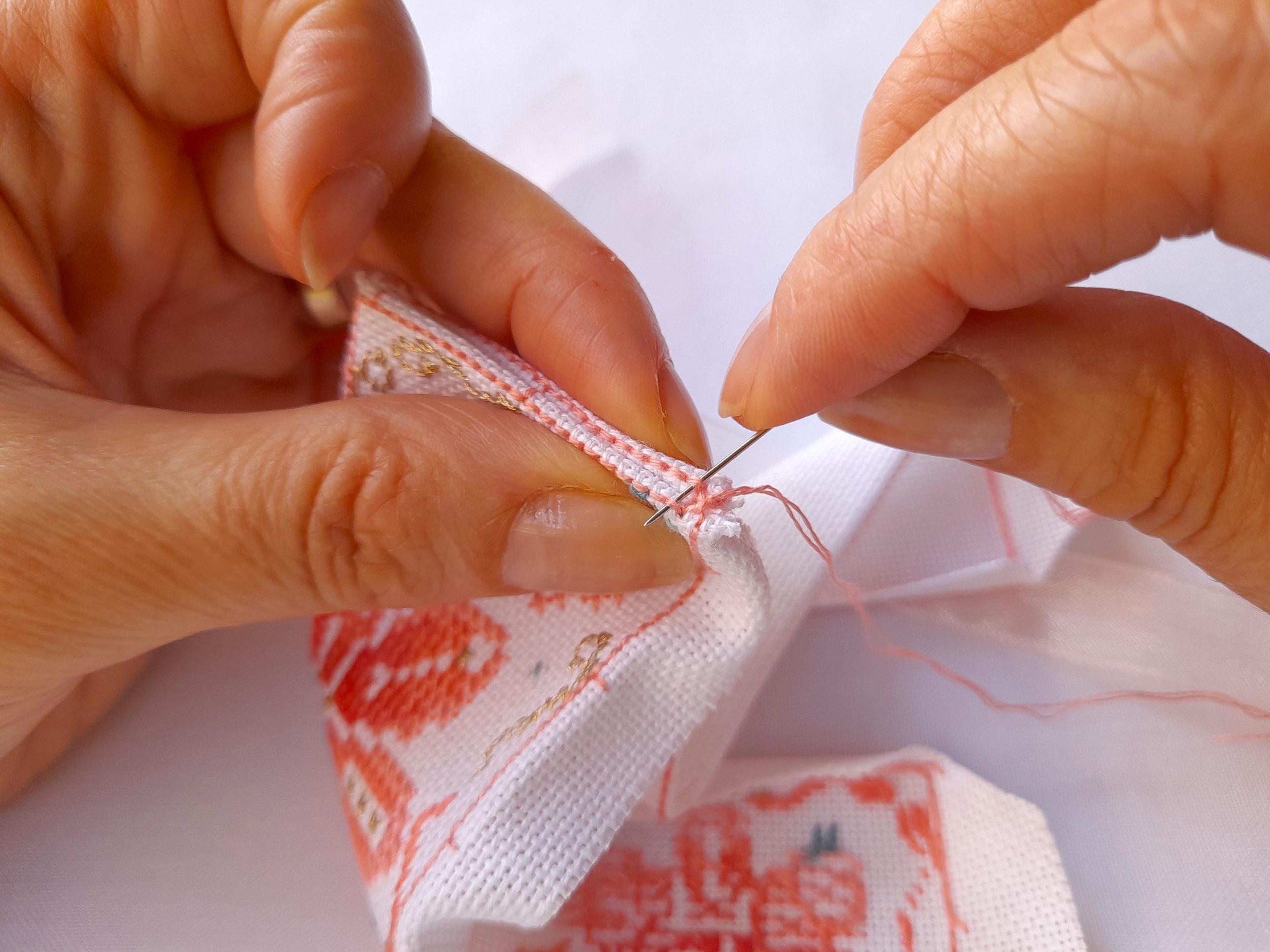
As I’m sure it happens to you too, when I take the needle and thread and begin to stitch, something inside me shifts: the rhythm of life slows down, my breathing softens, and my mind finds a place to rest.
It’s not just a pleasant feeling — research is beginning to show real benefits of embroidery and textile arts for mental health and overall well-being.
You might not know this, but before devoting myself entirely to embroidery, I worked for many years as a scientist.
Perhaps that’s why, when I talk about the benefits of cross stitch or any other handcraft, I like to know there’s a logical explanation — and, whenever possible, scientific evidence behind it.
Embroidery is a source of calm and creativity, yes — but it’s also a beautiful example of how a manual activity can have a real, measurable impact on our well-being.
🌿 What Science Says — Simply Explained
In recent years, reviews and studies have explored the impact of needlework — embroidery, knitting, crochet — on mental health.
A scoping review from 2024 concluded that these activities are associated with improvements in mood, a greater sense of achievement, purpose, and social connection.
Another study, published in Frontiers in Public Health, showed that engaging in arts and crafts predicts higher subjective well-being and lower feelings of loneliness, even after accounting for factors such as age or income.
In short: creating with your hands is good for you — and science agrees.
At a clinical level, in occupational therapy, embroidery is being rediscovered as a meaningful and transformative activity.
Some studies highlight its potential to shape identity, give purpose, and improve emotional health.
And although more research is still needed, one thing is clear: stitching brings well-being.
🪡 Why Embroidery Relaxes You
I’ve always been fascinated by how, after just a few minutes of stitching, everything grows quiet.
Perhaps you’ve felt it too — the simple act of repeating your stitches, listening to the sound of the thread passing through the fabric, slowly turns down the noise in your mind.
Embroidery combines something rare: rhythmic movement and gentle focus.
That balance helps silence racing thoughts, encourages a state of flow (that wonderful moment when everything just clicks), and activates a natural relaxation response.
In other words: stitching slows both your mind and your body.
And the best part — it’s not just intuition.
Scientific studies have observed that repetitive manual activities such as stitching, painting, or knitting reduce cortisol levels — the so-called “stress hormone” — and at the same time increase dopamine and serotonin, neurotransmitters linked to pleasure, calm, and motivation.
In other words, while you stitch, your brain is literally filled with signals of well-being.
You don’t need to stitch for hours; even a few minutes can bring calm.
And I don’t just say that from experience — science confirms it too.
🌸 Focus and Mental Clarity
There are days when your mind just won’t stop spinning, right?
It happens to me often — there’s always more to do, both personally and professionally, than there are hours in the day. Sounds familiar?
Yet when I sit down to stitch, everything narrows to one simple rhythm: the thread, the needle, the next cross.
Research on textile crafts has reported improvements in concentration and mental clarity, together with a general sense of emotional balance.
Large surveys reveal what you and I already knew deep down: the more we stitch, the calmer and happier we feel.
That’s why I always say embroidery doesn’t just create beauty — it organizes your thoughts.
Stitch by stitch, without hurry, everything falls back into place.
🌼 Self-Esteem, Achievement, and Purpose
You probably remember the joy of finishing a project after so many hours of patience and care.
That satisfaction is well deserved — completing a piece, big or small, strengthens your sense of self-efficacy, that quiet confidence that says, “I can do this, one step at a time.”
Scientific reviews confirm it: stitchers describe feelings of satisfaction, purpose, and well-being once they complete their projects.
And something even more beautiful — many mention the emotional bond and family legacy that pass from one generation to the next.
When we embroider, we’re not only creating an object — we’re also weaving a story.
And that story leaves its mark.
🤍 Connection and Belonging
Even though embroidery can be an intimate and quiet activity, it also builds community.
You and I both know this: sharing progress, showing a new stitch, or simply chatting while we sew creates very special bonds.
Studies on knitting and crochet show that shared practice increases happiness and feelings of connection.
I’m convinced embroidery brings the same benefits — each stitch ties us closer together than we imagine.
🌿 A Realistic Note
Recent reviews are optimistic but also honest: we still need more rigorous studies to better understand the “how” and “how much” of these benefits.
Even so, the consensus is clear: textile arts are an accessible, real, and powerful tool for well-being.
We don’t need everything to be measured to feel its effects.
Sometimes, it’s enough to notice how, after just a few minutes of stitching, the world feels a little softer.
🌸 How to Stitch “Without Hurry”: Small Practices
🌿 Create a little ritual. Sit comfortably, plant your feet, take three deep breaths, and tell yourself: Today I’m just going to enjoy a few stitches.
🌿 Listen to the thread. Notice the sound as it passes through the fabric and the tension between your fingers — it’s your reminder to stay present.
🌿 Take breaks. Every 20–30 minutes, relax your shoulders, look out the window, stretch your neck. Taking care of yourself is part of stitching too.
🌿 Start small. A bookmark, a keychain, or a biscornu are perfect projects to feel progress without pressure.
🌿 Choose your colors according to your mood. If you’re seeking calm, go for soft blues or greens; if you need energy, choose warm tones.
See? In the end, embroidery is also a form of self-care 🤍
🌷 If You Need It Today, Start Here
I invite you to give yourself fifteen unhurried minutes for a few stitches.
Don’t think about the result — just enjoy the process.
Because embroidery isn’t a race; it’s a gentle way to care for yourself, to breathe, and to find balance in everyday life.
If you’re looking for easy ideas to begin, you’ll find guides and projects on the blog and in the shop, designed to help you enjoy the journey as much as the finished piece.
Pick something that inspires you — and enjoy this wonderfully mindful craft!
💜 Loved this post?
Stay close for new ideas, tutorials, and videos. Subscribe here and receive tutorials, ideas… and a warm 50% welcome discount on your first order.
🧵 References
1. Bukhave, E. B., Creek, J., Linstad, A. K., & Frandsen, T. F. (2025).
The effects of crafts-based interventions on mental health and well-being: A systematic review.
Australian Occupational Therapy Journal, 72(1), e70001.
https://doi.org/10.1111/1440-1630.70001
2. Burns, P., & Van der Meer, R. (2021).
Happy hookers: Findings from an international study exploring the effects of crochet on wellbeing.
Perspectives in Public Health, 141(3), 149–157.
https://doi.org/10.1177/1757913920911961
3. Drexel University News (Kaimal, G., et al.). (2016).
At Any Skill Level, Making Art Reduces Stress Hormones.
Drexel University Press Release.
https://drexel.edu/news/archive/2016/june/art_hormone_levels_lower
4. Griffin, E. (2023).
Crafting calm: Unravelling the benefits of crochet.
I, Science – The Science Magazine of Imperial College London.
https://isciencemag.co.uk/features/crafting-calm-unravelling-the-benefits-of-crochet/
5. Keyes, H., Gradidge, S., Forwood, S. E., Gibson, N., Harvey, A., Kis, E., Mutsatsa, K., Ownsworth, R., Roeloffs, S., & Zawisza, M. (2024).
Creating arts and crafting positively predicts subjective well-being.
Frontiers in Public Health, 12, 1417997.
https://doi.org/10.3389/fpubh.2024.1417997
6. Le Lagadec, D. (2024).
A scoping review on the impact of needlecraft on mental health and well-being.
Journal of Occupational Science.
https://doi.org/10.1080/14427591.2024.1481123
7. Riley, J., Corkhill, B., & Morris, C. (2013).
The benefits of knitting for personal and social well-being in adulthood: Findings from an international survey.
British Journal of Occupational Therapy, 76(2), 50–57.
https://doi.org/10.4276/030802213X13603244419077
8. von Kürthy, H., Aranda, K., Sadlo, G., & Stew, G. (2023).
Embroidering as a transformative occupation.
Journal of Occupational Science, 30(4), 445–459.
https://doi.org/10.1080/14427591.2022.2104349